5/9/12

IS OUR FUTURE STILL BOLD ?

Delphine Borg
BIENNALE DI VENEZIA 2012, LUXEMBOURG PAVILION PROPOSAL, IN ANSWER TO FUTURA BOLD THEME


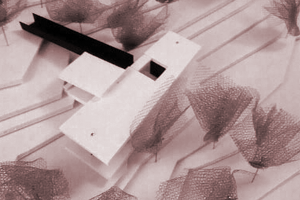
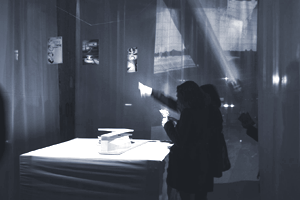
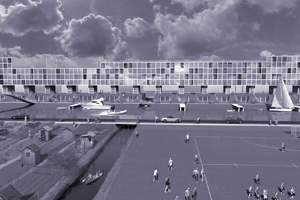
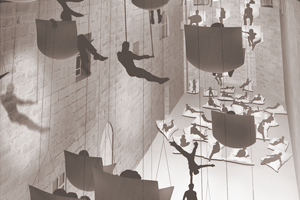
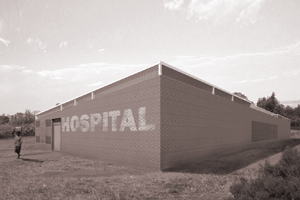
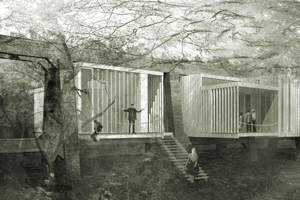
1927 : Futura Bold, 2012 : Is our future still bold? What happened to the Bauhaus main concepts? What happened to the essential relations between Nature, Humans and Technologies?After many years of economic prosperity and abundance, governments and institutions now appear to have to protect their citizens from both rational and irrational fears of the future. Rules and regulations relevant to urban design and architecture are created.As a result, freedom of design in architecture and landscape design is so constrained by those protectionist norms, that newer realizations show the evidence of severe consequences. Windows often don’t open anymore, circulations are partitioned and enclosed, handrails are getting higher and higher. Some tree species, such as birch, are now forbidden in cities because of their allergenic potential. Humanity is already in a situation where people live into hermetic spaces in some parts of the world, totally isolated from nature.The two entities gradually become more and more fragile because of each other - but a world without interaction between the different elements can not naturally survive.The project proposes an installation in each of the six rooms of a given Venetian apartment, where each room reflects a different conflictive relationship between Humans and Nature, highlighting the urgent necessity for an enhanced relationship.As a statement, the rooms are called Isolation, Preservation, Selection, Partition, Immersion and Frustration. The proposed installation is made of simple resources : white wooden volumes, whites curtains, limpid glass globes, and focussed light sources emphasizing the objects of the exhibition : water and vegetal subjects and their relation to the public.


ISOLATION
When the visitors enter in this room they first notice many glass globes of different sizes laying it the shelves, not unlike an old druggist store. Each globe contains either a glass full of water or a 3D print of a plant. The 3D prints refer to new kinds of fossils, available to reproduce with technology, but slowly disappearing from real life. The enclosed water evaporates and condensates against the globes, reminding us that natural elements in an ecosystem need freedom to interact. In contrast to those static representations of nature, the visitors can hear recorded sounds of river and wind in the leaves coming from the installation. To complete the atmosphere of the room, whose natural light is filtered by translucent curtains, little spotlights are located under each globe, projecting shadows of the 3D prints and reflection of the water all over the room.
PRESERVATION
Hidden in a wooden fortress, lit as in an incubator, a common-looking plant is placed in the center of the room,  with natural light  filtered by the surrounding curtains. The scenography that highlights the plant reveals its true nature  : a rare specimen that needs high protection.


SELECTION
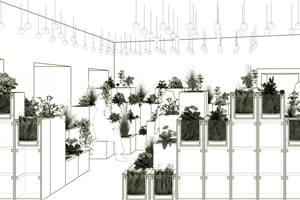
The room hosts a lettuce garden whose vegetables are set like a city, with the hierarchy of Avenues and Boulevards to streets, monuments to common buildings. The glass globes protect only a few specific vegetables as opposed to the rest of the garden. As a metaphor of the city, some specific vegetables/buildings are intended to be maintained forever while others are just a piece of the whole entity and meant to be replaceable.


PARTITION
In the rush of the Biennale, this room offers the visitors an opportunity to rest by laying on a large hammock. But one only can enjoy one’s rest if one accepts the idea of being suspended above an army of aggressive plants - here little domestic cactuses. Like in a zoo, this installation uses the delicious feeling of fear in a perfectly safe place - as long as the public trusts the  technology that protects them.


IMMERSION
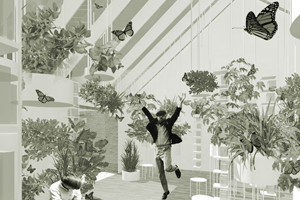
This fourth room offers the visitors a promenade into what seems like a common indoor garden. However at the door the public is warned that the garden, which appears friendly and domestic, is in fact highly allergenic. People are free to turn back or enter, with a mask if needed. 

FRUSTRATION 

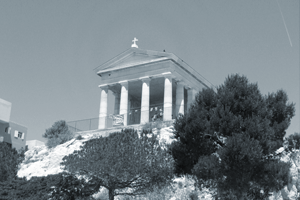
The last corridor, which leads to the exit of the exhibition, offers the visitors free postcard picturing faraway landscape on their way out. The sophisticated depictions of deep wild nature are part of the contrasted relationship people have with nature. The fantasized pictures of generous unknown landscapes create frustration as people are excluded from actual nearby nature.